For years, Kraft Macaroni & Cheese had a taste that millions of people instantly recognized. Then, sometime after Kraft announced it would remove Yellow 5 and Yellow 6 from its iconic product, a familiar complaint began appearing online:
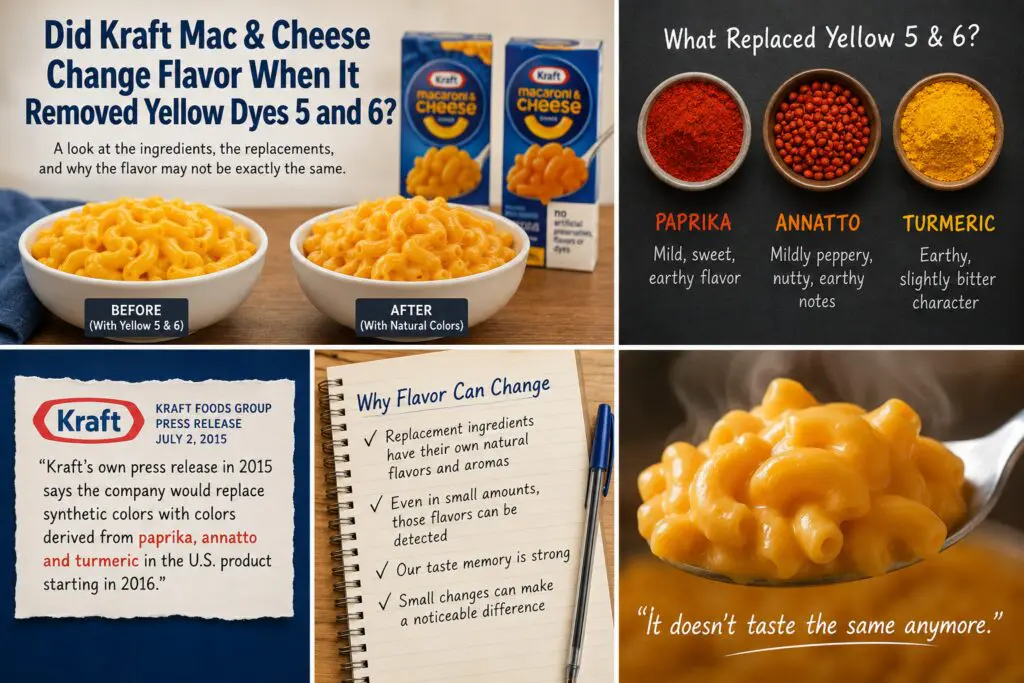
“It doesn’t taste the same anymore.”
The usual response from food scientists, journalists, and internet experts was predictable. Food dyes don’t have flavor, they said. Therefore, removing the dyes couldn’t possibly have changed the taste.
That argument misses the point.
The question isn’t whether Yellow 5 or Yellow 6 tasted like anything. The real question is what Kraft used to replace them.
In its 2015 announcement, Kraft stated that synthetic colors would be replaced with colors derived from paprika, annatto, and turmeric in the U.S. version of the product beginning in 2016.
Those ingredients were chosen because they produce the familiar orange-yellow appearance consumers expected. But unlike synthetic dyes, paprika, annatto, and turmeric are derived from plants — and plants have flavors.
Before imagining that Kraft dumped spoonfuls of curry powder into every box… That’s not what happened. The coloring ingredients were highly processed extracts used in relatively small amounts, so the flavor impact would likely be subtle.
But subtle is not the same as nonexistent.
Anyone who cooks regularly knows that paprika contributes a mild earthy sweetness. Turmeric has a distinctive earthy, slightly bitter character. Annatto is often described as mildly peppery, nutty, or earthy. Even in extract form, these ingredients originate from plants that contain aromatic compounds responsible for flavor and aroma.
Food manufacturers routinely spend enormous amounts of money fine-tuning recipes because tiny changes matter. A fraction of a percent difference in a seasoning blend can alter how consumers perceive a product. That’s especially true for foods people have eaten for decades and know by memory.
Taste is also more complicated than many people realize.
Flavor is not just what happens on the tongue. Aroma, appearance, and even expectations all influence perception. If the replacement coloring ingredients altered aroma compounds even slightly, consumers could legitimately perceive a difference in flavor. That doesn’t mean they were imagining things.
In fact, Kraft itself apparently anticipated that consumers might notice changes. The company spent years testing reformulated versions before rolling them out nationally. Manufacturers don’t conduct extensive taste testing if they believe a recipe change is completely undetectable.
Could nostalgia be part of the story? Certainly.
Human memory isn’t a perfect recording device. Many adults comparing today’s product to memories from childhood are also comparing different ingredients, different manufacturing processes, and decades of changing tastes.
But that doesn’t automatically mean consumers are wrong when they say the product changed.
The most reasonable conclusion is also the simplest: removing Yellow 5 and Yellow 6 probably didn’t alter the flavor by itself. However, replacing those dyes with colorings derived from paprika, annatto, and turmeric may have introduced subtle differences in flavor, aroma, or overall sensory experience.
For people who grew up eating the original version, those small differences can be enough to notice. When millions of consumers independently say, “This tastes different,” it’s worth considering that they might be detecting a real change rather than suffering from a mass delusion.
So the conclusion is that Yellow 5 and 6 dyes may not have had flavor but the replacements just might have.
Leave a Reply